
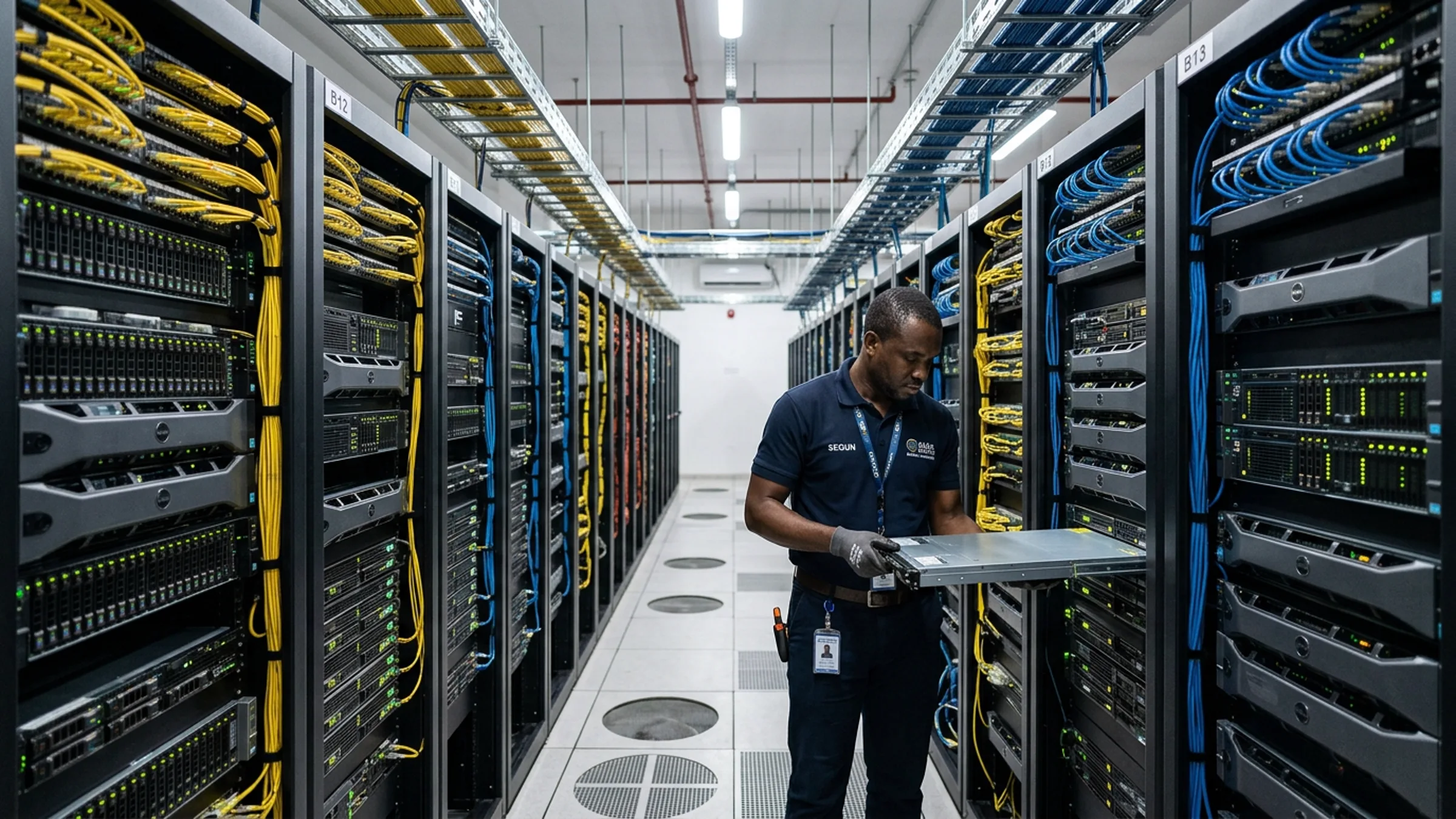
Your Infrastructure Is Mission-Critical. Every Installation Matters.
Rack-and-stack, cabling, server deployment and Smart Hands for data centres and cloud infrastructure in Nigeria.
Digital Infrastructure Doesn't Begin in the Cloud. It Begins With What Is Built Beneath It.
Behind every cloud service, enterprise application and connected digital platform is physical infrastructure that must be properly installed, connected, verified and maintained.
Integrated Solutions Technology provides data centre equipment installation, rack-and-stack, structured cabling, server and storage deployment, smart hands and technical infrastructure support in Nigeria.
Whether you're expanding a data centre environment, deploying equipment in a colocation facility or supporting a remote engineering team, we help turn approved technical requirements into organised, documented physical infrastructure.
Modern digital services rely on a physical foundation of servers, storage systems, network equipment, power connections and communication infrastructure.
For data centre operators, the quality and organisation of these installations can influence maintainability, infrastructure visibility and the ease of future expansion.
For colocation customers and cloud infrastructure teams, the challenge may be different.
Their equipment could be located in a facility managed by another organisation. Engineers responsible for deployment may work from another city or country. Access may be restricted, work windows controlled and technical changes subject to strict approval procedures.
In these environments, the details matter.
Correct equipment identification, suitable rack mounting, approved cabling, clear port records and reliable handover information are essential components of a controlled implementation.
Integrated Solutions Technology helps organisations manage the physical activities within their approved data centre infrastructure projects.
Execute With Greater Technical Clarity
Translate defined installation requirements into organised equipment mounting, connection and verification activities.
Support Distributed Engineering Teams
Provide suitable onsite assistance for authorised technical tasks directed by remote infrastructure personnel.
Maintain Better Infrastructure Visibility
Use relevant equipment inventories, rack elevations, cable schedules and technical records to make installed assets easier to identify.
Plan Around Operational Constraints
Coordinate work according to facility rules, approved change windows, equipment requirements and applicable safety procedures.
Physical infrastructure deployment and technical support for data centre operators, colocation customers, enterprise IT teams and remote technology providers.
The Physical Infrastructure Services Behind Enterprise Computing.
Data centre environments contain multiple technical layers that must be implemented in the correct sequence.
Equipment must fit its designated rack. Network connections must reach the approved endpoints. Power requirements must be understood. Changes must be authorised. Completed work must be verified and documented.
We support defined physical infrastructure activities for enterprise data centre projects, colocation deployments and remote infrastructure teams.

Install Enterprise Hardware With the Right Preparation.
Servers, storage systems, switches and other infrastructure equipment require suitable mounting, physical positioning and connection arrangements.
We help organisations carry out approved hardware installation and rack-level deployment tasks according to equipment specifications and facility requirements.
- Rack-and-stack services
- Enterprise server installation
- Storage equipment installation
- Network equipment deployment
- Rack accessories and consumables supply
- Equipment moves, adds and changes
Before work begins, relevant considerations may include rack-unit availability, mounting hardware, equipment weight, airflow requirements, power connections and approved rack elevations.
Wherever Your Equipment Operates, the Physical Details Matter.
Different data centre operating models create different technical responsibilities.
Understanding who owns the facility, who manages the equipment and who authorises the work is fundamental to planning a suitable deployment.
Colocation Data Centre Deployments
Approved equipment installation, cabling, rack changes and technical documentation within customer-allocated space.
Enterprise Data Centres
Physical server, storage and network infrastructure work within organisation-managed data centre environments.
Cloud Infrastructure Equipment
Rack-level installation, connection and physical support for approved infrastructure supporting cloud-hosted services.
Private Cloud & Virtualisation Hardware
Suitable computing, storage and network equipment deployment supporting customer-managed virtualisation environments.
Edge Computing & Remote Infrastructure Sites
Appropriate equipment mounting, cabling, inspection and remote-directed technical support in smaller distributed facilities.
Disaster Recovery & Secondary Infrastructure Sites
Suitable physical deployment and documentation for approved secondary computing environments.
Data Centre Expansion Projects
Equipment additions, rack changes, network cabling and related infrastructure implementation within existing facilities.
Carrier & Network Equipment Areas
Suitable network equipment mounting, fibre connections, patching and technical records within authorised environments.
Customer Cages & Dedicated Racks
Equipment identification, approved installation changes, cabling and smart hands tasks within allocated customer areas.
Small Installation Errors Can Create Bigger Operational Problems.
Equipment Arrives Without a Complete Installation Plan
The challenge
Hardware may be delivered before rack space, mounting materials, power connections or cabling requirements have been confirmed.
How we address it
Review relevant installation prerequisites, equipment specifications and approved technical records before deployment.
Disorganised Rack Cabling
The challenge
Unclear cable routes and inconsistent labels can make troubleshooting and equipment changes more difficult.
How we address it
Assess suitable cable organisation, port mapping, labels and rack remediation within the approved scope.
Remote Teams Need Physical Access to Equipment
The challenge
Engineers responsible for a system may be located far from the facility where hardware intervention is required.
How we address it
Provide suitable authorised smart hands assistance for clearly defined tasks and report the outcome.
Equipment Moves Create Uncertainty
The challenge
Relocating equipment can affect power, cabling, rack positions and connected services.
How we address it
Define equipment identifiers, destination locations, affected connections and verification requirements before executing approved changes.
Incomplete Technical Documentation
The challenge
Missing inventories, outdated rack elevations and incomplete port records can make infrastructure difficult to manage.
How we address it
Prepare or update relevant records using verified installation information and the agreed documentation scope.
Changes Must Be Coordinated Around Live Systems
The challenge
Data centre environments may contain active infrastructure that cannot be interrupted without appropriate planning.
How we address it
Follow defined change procedures, access rules, maintenance windows and relevant recovery arrangements before carrying out authorised work.
Defined Work. Authorised Execution. Clear Handover.
Data centre infrastructure implementation should start with a detailed understanding of the equipment, facility environment and approved deliverables.
We help organisations organise the physical work around technical requirements and site procedures.
Review the Technical Scope
Confirm equipment lists, drawings, designated rack positions, connectivity requirements and the intended project outcome.
Assess Deployment Readiness
Review relevant access permissions, rack availability, mounting requirements, cable materials, approved power connections and technical dependencies.
Coordinate the Work
Establish suitable implementation sequences, remote contacts, approved change windows and responsibilities.
Install & Verify
Carry out authorised installation activities and perform relevant checks against the agreed technical scope.
Document & Handover
Provide the agreed equipment records, installation notes, cable schedules, test results and outstanding actions.
Carefully Planned Infrastructure. Clearly Defined Work.
Illustrative images of typical installations and work environments.
Enterprise Rack-and-Stack Deployment
Suitable servers, switches and storage equipment installed in organised racks according to approved installation requirements.

Fibre & Copper Cabling
Appropriate network cabling and labelled connections supporting enterprise computing environments.

Smart Hands Technical Support
Onsite equipment checks and authorised physical activities coordinated with remote technical teams.

Infrastructure Verification & Documentation
Technical staff reviewing installed assets, relevant connections and agreed handover records.
Questions Data Centre Operators and Infrastructure Teams Ask.
Data centre infrastructure services cover the physical and technical systems required to support computing and network equipment.
Depending on the scope, they may include rack installation, servers, storage, cabling, switching, equipment changes, infrastructure testing, documentation and onsite technical support.
Integrated Solutions Technology offers data centre design and infrastructure planning, equipment installation, rack-and-stack, fibre and structured cabling, server and storage deployment, equipment changes, infrastructure verification, smart hands and technical documentation.
Each engagement is subject to an approved scope and the relevant facility's operating procedures.
Suitable server installation may be carried out where the colocation provider permits the work and the customer has authorised access and installation activities.
Equipment dimensions, rack positions, mounting hardware, power and network requirements should be confirmed before deployment.
Rack-and-stack is the physical process of mounting suitable IT equipment in a rack or cabinet and carrying out associated installation tasks.
It may include rail installation, hardware positioning, power connections, cabling and equipment identification according to the approved scope.
Pricing depends on equipment quantities, rack positions, installation complexity, hardware weight, site location, required technicians and associated cabling or testing.
A quotation should be based on the actual equipment list and facility requirements.
A data centre operator manages the facility and its supporting infrastructure.
A colocation customer typically uses allocated space, racks or cabinets for its own equipment under an agreement with the operator.
Responsibilities for physical work, power, network connections and access differ according to the contract.
Work in a third-party facility may be considered where the operator allows external technical personnel and the required access approvals can be obtained.
Integrated Solutions Technology should not be assumed to have standing access to every Nigerian data centre.
Integrated Solutions Technology offers Smart Hands & Remote-Team Support for suitable physical tasks.
The exact facility, equipment, authorised actions, technical skills and access arrangements must be confirmed for each request.
Typical authorised tasks may include equipment inspections, device identification, cable tracing, suitable patch changes, compatible component replacement and physical verification.
The actual permitted activities depend on the site rules, technician competence and agreed task instructions.
A specifically authorised restart may be considered where the correct device has been identified and the required change approval is in place.
Power cycling can affect active services, so it should not be carried out without appropriate instructions and safeguards.
Suitable enterprise storage and network equipment can be installed according to manufacturer requirements, compatible rack arrangements and approved technical specifications.
Configuration and specialist integration must be included separately where required.
Integrated Solutions Technology offers enterprise hardware and equipment procurement.
Actual product availability, warranties, licensing and manufacturer support arrangements must be confirmed for each quotation.
Suitable fibre installation and connection work can be included within a defined project.
The scope should address cable types, pathways, connector compatibility, patching arrangements and relevant testing.
Yes, suitable structured copper cabling can be planned and installed according to approved requirements.
Cable category, termination, route management and verification should reflect the intended application and technical specification.
A rack elevation is a diagram or schedule identifying equipment positions within a rack, usually by rack-unit location.
It helps teams plan installation, identify devices and maintain relevant physical records.
Consistent identifiers help engineers relate physical connections to equipment, ports and technical records.
This can simplify authorised changes, fault investigation and infrastructure maintenance.
Rack remediation may be considered after reviewing the existing equipment, connections, cable routes and operating conditions.
Work affecting active systems must be properly authorised and planned to avoid unintended disruption.
Equipment relocation can be undertaken within an approved project where the device, destination, dependencies and necessary resources are confirmed.
The plan should address power, network connections, equipment handling, maintenance windows and post-move verification.
Moves, adds and changes are approved physical modifications to an existing infrastructure environment.
Examples include relocating equipment, installing new hardware and altering documented connections or components.
Yes, suitable onsite tasks can be structured around an authorised remote engineer's instructions.
The task should clearly identify the equipment, required action, communication method, permitted changes and completion criteria.
Useful details include the facility location, rack identifier, equipment model or asset ID, exact required action, authorised technical contact and relevant change approval.
Runbooks, rack elevations and port schedules may also be required.
Relevant equipment inventories and physical records can be included in an agreed assessment or documentation project.
The level of verification should be defined, including any asset identifiers, rack positions, cable connections and photographic evidence required.
Testing depends on the approved scope.
It may include relevant physical checks, equipment identification, cable verification, power-connection confirmation and defined connectivity tests.
Formal performance, resilience and acceptance testing must be separately specified if required.
ANSI/TIA-942 is a data centre infrastructure standard covering technical requirements relevant to data centre facilities.
Its scope includes telecommunications infrastructure and other data centre systems. Formal certification is separate from routine installation work.
No.
Data centre Tier certification requires the applicable assessment process through the relevant certification body.
Individual equipment installation or use of an industry standard does not automatically establish facility certification.
Formal Tier III design and certification involve specialist engineering and independent assessment.
Integrated Solutions Technology's confirmed data centre portfolio supports relevant infrastructure planning and physical implementation. Any claim to deliver certified Tier III facility design requires separate verification of the necessary expertise and authorisation.
The current service portfolio includes relevant power and IT infrastructure solutions, but specialist data centre electrical distribution, mechanical cooling and fire protection engineering are separate disciplines.
Such work should only be offered where appropriately qualified resources and responsibilities are confirmed.
Yes.
Physical servers, storage arrays, switches and cabling may support cloud infrastructure even when cloud software and platform administration are handled by another team.
The physical deployment scope should be distinguished from cloud management and orchestration.
Public cloud architecture, platform administration, managed Kubernetes and cloud migration are not confirmed as part of the current 41-service portfolio.
Such capabilities should not be advertised without additional evidence.
Suitable physical equipment installation, cabling and remote technical support can be considered for smaller edge or distributed infrastructure sites.
The deployment must account for the site's equipment, access, environmental and power requirements.
Some tasks can be completed without affecting live services, while others require authorised maintenance windows or recovery arrangements.
The outcome depends on the architecture, dependencies and exact work. Zero downtime cannot be guaranteed without a verified technical plan.
Duration depends on hardware quantity, complexity, site access, rack readiness, cabling, configuration and verification requirements.
A realistic schedule should follow review of the approved equipment list and implementation scope.
Equipment receiving, handling or installation logistics may be discussed where permitted by the facility and covered by the agreed scope.
Storage, custody, transport, risk of damage and insurance responsibilities must be defined beforehand.
Depending on the scope, relevant documentation may include equipment inventories, rack elevations, cable and port schedules, installation notes, test results and outstanding actions.
Sensitive configuration data must be handled through appropriate secure procedures.
Suitable maintenance and smart hands arrangements may be discussed according to equipment, location, technical requirements and available resources.
Continuous coverage and guaranteed response times must be explicitly agreed.
Yes, suitable equipment upgrades, physical changes and related installation activities can be scoped.
The project should consider compatibility, capacity, operating dependencies and the requirements of the existing facility.
Provide the facility location, equipment list, rack requirements, available drawings, cabling scope, access conditions and required installation or verification activities.
The information helps establish the required technical resources and quotation.
Contact Integrated Solutions Technology with details of your infrastructure environment, deployment requirements and available technical documentation.
We can review the work and discuss an appropriate project scope, site prerequisites and quotation.
Plan Your Next Infrastructure Requirement
Share the project, issue or infrastructure requirement. Integrated Solutions Technology will review the technical need and help determine the appropriate next step.
Your Infrastructure Has a Job to Do. Make the Deployment Count.
From enterprise rack-and-stack and fibre cabling to server deployment, equipment changes and smart hands, every physical task contributes to a data centre environment that must remain understandable and maintainable.
Whether you're deploying new equipment, expanding a colocation footprint or coordinating a remote engineering project in Nigeria, Integrated Solutions Technology can help you define and execute appropriate infrastructure work.