
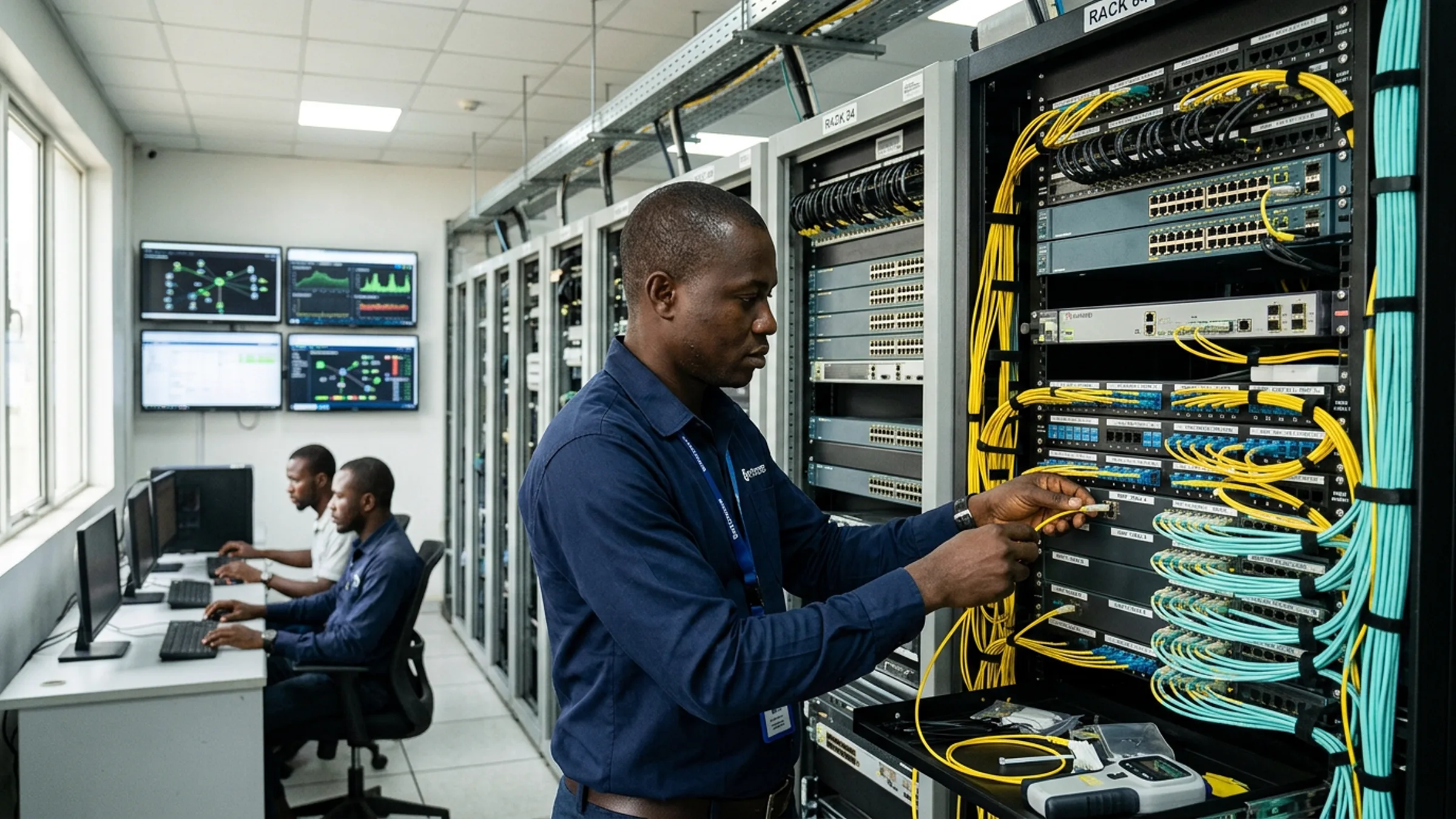
Every Connection Depends on the Infrastructure Behind It.
Fibre cabling, network equipment deployment and field support for telecom operators and ISPs in Nigeria.
A Network Is Only as Manageable as the Infrastructure Supporting It.
When customers depend on your network, the quality of the physical infrastructure supporting it matters.
Integrated Solutions Technology provides fibre optic cabling, network equipment installation, rack-and-stack, server infrastructure and onsite technical support for telecommunications companies and Internet Service Providers in Nigeria.
From approved network deployments and equipment-room installations to smart hands, infrastructure upgrades, testing and documentation, we help operators and technical teams deliver the physical work behind their connectivity services.
Internet and telecommunications services depend on an extensive combination of physical assets.
Fibre cables connect equipment and locations. Switches, routers and optical devices handle traffic. Racks and equipment rooms provide organised installation environments. Power infrastructure supports active devices. Technical records help engineers understand how everything connects.
When these systems are poorly installed or insufficiently documented, network operations become harder to manage.
An incorrect fibre patch may interrupt a connection. A crowded equipment rack can complicate maintenance. Inaccurate port records can delay fault isolation. Missing installation prerequisites can disrupt equipment rollout schedules.
For operators with several sites, these challenges increase as technical work must be coordinated across locations and with remote teams.
Integrated Solutions Technology helps organisations address the practical infrastructure tasks needed to support their approved network designs.
Execute Network Deployments With Clarity
Install suitable equipment and cabling according to approved technical specifications and site requirements.
Make Connections Easier to Trace
Maintain appropriate cable labels, port references, equipment identifiers and installation records.
Support Remote Network Teams
Provide suitable physical assistance for authorised tasks when the responsible engineers are not onsite.
Prepare for Infrastructure Expansion
Support additional equipment, new links and suitable network upgrades through defined technical implementation.
Physical network infrastructure and technical deployment support for ISPs, telecommunications operators and distributed network teams.
Practical Infrastructure Services for Network Operators.
Telecommunications infrastructure includes access networks, aggregation environments, equipment rooms, enterprise connectivity sites and data centre facilities.
Each environment has different technical and operational requirements.
We help organisations implement suitable physical networking and supporting IT infrastructure according to approved designs, equipment specifications and regulatory responsibilities.

Connect the Equipment. Organise the Physical Network.
Fibre optic infrastructure provides high-capacity connections between compatible telecommunications and networking equipment.
We help organisations assess and implement suitable fibre and structured cabling for approved premises, equipment facilities and defined connectivity projects.
- Fibre optic cabling
- Structured LAN cabling
- Fibre patching and connection organisation
- Suitable cable routing
- Rack cable management
- Cable labelling and port mapping
- Defined cable verification activities
Where a project involves external fibre routes, civil works or public rights-of-way, the applicable permits, specifications and specialist installation responsibilities must be established before work begins.
Infrastructure Across the Connectivity Ecosystem.
Connectivity providers may operate several classes of technical environment, each requiring different physical equipment and support arrangements.
Internet Service Provider Equipment Rooms
Suitable network racks, routing and switching equipment, structured connections and approved support activities.
Points of Presence (PoPs)
Equipment mounting, fibre patching, network cabling and technical documentation for approved network presence locations.
Telecommunications Data Centres
Enterprise network equipment installation, rack organisation, structured fibre connections and agreed infrastructure verification.
Fibre Distribution & Aggregation Locations
Approved cabling, network equipment installation, connection identification and relevant port documentation.
Enterprise Customer Connectivity Sites
Suitable customer-premises network equipment installation and physical network support under approved provider requirements.
Network Operations Support Locations
Enterprise computing, structured cabling, network hardware and facility support for approved operations environments.
Distributed Equipment Sites
Suitable equipment inspections, authorised hardware handling and remote-team technical assistance.
ISP Administrative & Technical Offices
Office networking, servers, storage, firewalls, appropriate power solutions and technical maintenance.
Network Expansion & Upgrade Projects
Equipment additions, rack remediation, suitable cabling changes and technical handover for approved infrastructure improvements.
Solve Physical Infrastructure Problems Before They Become Larger Issues.
Poorly Documented Fibre Connections
The challenge
Engineers may struggle to identify the correct fibres, patch panels and endpoints when records are incomplete.
How we address it
Review available connection information and plan appropriate labelling, tracing, port schedules and verified documentation.
Disorganised Equipment Racks
The challenge
Dense patching, unmanaged cables and unclear equipment positions can make routine maintenance more difficult.
How we address it
Assess rack layout, cable pathways and relevant remediation activities, with approved changes planned around active services.
Equipment Deployment Delays
The challenge
Routers, switches and other network devices may arrive before equipment-space and installation prerequisites have been confirmed.
How we address it
Review mounting accessories, rack availability, connectivity requirements, relevant power connections and authorised implementation steps.
Remote Teams Need Onsite Assistance
The challenge
Central engineering teams may be responsible for systems located far from their primary offices.
How we address it
Provide suitable smart hands assistance for clearly defined equipment inspections, authorised changes and technical reporting.
Ageing Network Hardware
The challenge
Older equipment may have capacity limitations, compatibility challenges or diminishing manufacturer support.
How we address it
Review relevant hardware and assist with appropriate replacement, equipment upgrades and technical implementation.
Power Requirements at Distributed Facilities
The challenge
Network equipment at remote or smaller locations may require a carefully planned electrical supply and backup arrangement.
How we address it
Assess identified loads and consider suitable power solutions, subject to equipment compatibility and specialist electrical engineering.
Technical Execution Begins With a Clear Deployment Scope.
Network infrastructure work should be coordinated with the teams responsible for system design, service operation and approved technical changes.
A defined implementation scope helps align physical tasks, equipment requirements and acceptance criteria.
Understand the Network Environment
Review the facility, equipment, planned connections, operating requirements and project objectives.
Confirm Technical Prerequisites
Establish relevant designs, equipment specifications, route information, access approvals, power requirements and dependencies.
Plan Authorised Implementation
Define the installation sequence, responsible contacts, approved change windows, required tools and verification steps.
Carry Out the Physical Work
Perform agreed equipment installation, cabling and supporting technical tasks within the approved scope and applicable site procedures.
Test, Document & Handover
Record relevant installation details, equipment identifiers, port connections, actual test results and outstanding actions.
Organised Infrastructure for Connected Operations.
Illustrative images of typical installations and work environments.
Fibre Optic Distribution & Patching
Suitable fibre patch panels, labelled connections and organised cable pathways within approved communications environments.

ISP Router & Switch Deployment
Enterprise networking equipment installed in suitable cabinets with relevant power and connectivity arrangements.
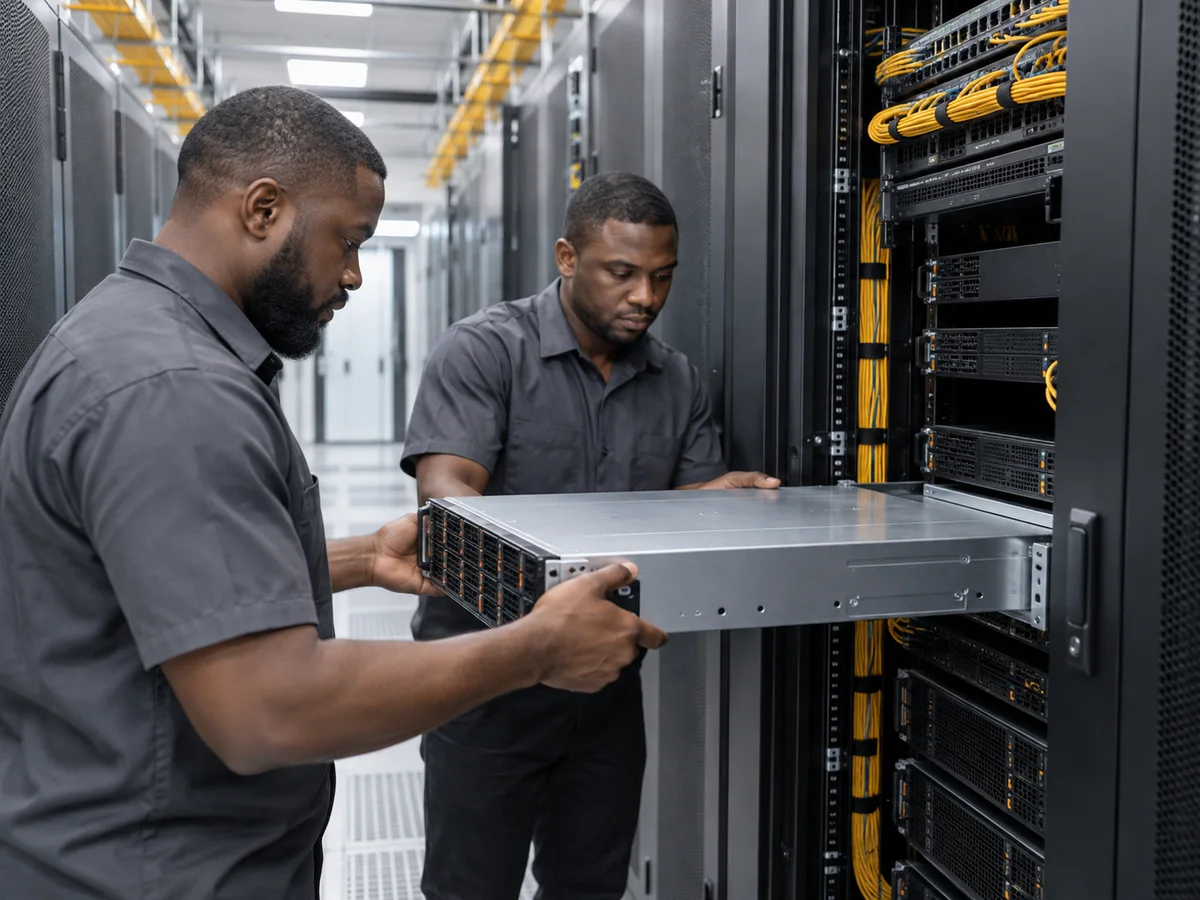
Network Point-of-Presence Infrastructure
Racks, structured cabling and supporting network hardware deployed within approved telecommunications facilities.

Smart Hands & Network Equipment Support
Onsite technicians inspecting equipment, checking physical connections and carrying out authorised remote-directed activities.
Answers for Network Operators, ISPs and Technical Teams.
An ISP may require network routers, switches, suitable fibre or other backhaul connections, customer connectivity equipment, network security, computing systems, power infrastructure and technical operating facilities.
The architecture depends on the provider's network design, service model, subscriber requirements and licensing obligations.
Integrated Solutions Technology offers network equipment installation, fibre optic cabling, structured cabling, rack-and-stack, server and storage installation, technical equipment changes, smart hands and infrastructure documentation.
The exact scope depends on the project requirements and confirmed technical capabilities.
Suitable network equipment installation can be considered within an approved project.
Tasks may include physical mounting, cable connections, suitable configuration work and agreed verification.
Advanced carrier-network configuration must be explicitly scoped.
Network hardware procurement may be considered according to the required manufacturer, model and technical specifications.
Availability, licensing, support terms and compatibility should be verified before quotation.
Fibre optic cabling is one of Integrated Solutions Technology's service offerings.
The specific installation method, route, permits, specialised equipment and verification requirements must be confirmed for each project.
Backbone fibre provides high-capacity links between major network locations.
Metro fibre generally connects locations within a metropolitan area, while access fibre connects network infrastructure closer to end-user premises.
The exact network topology and terminology depend on the operator's architecture.
External fibre installation requires a separately verified scope addressing route conditions, construction methods, cable specifications, permits and qualified personnel.
Underground civil works, pole infrastructure and aerial deployment should not be assumed to be included in ordinary premises cabling.
Projects using public land, roads or other controlled routes may require relevant right-of-way permissions and additional authorisations.
The applicable requirements depend on the route, jurisdiction and project. The responsible operator or project owner should confirm them before installation.
Fibre splicing and termination may be considered where appropriately skilled personnel and equipment are available.
The installation specification should define cable type, connector requirements, acceptable losses and required test records.
An optical time-domain reflectometer (OTDR) can help characterise events and distance along a fibre link.
An optical loss test set (OLTS) measures end-to-end insertion loss.
The appropriate testing method depends on the cable plant, project specification and applicable standards. OTDR results do not automatically replace insertion-loss verification.
Testing helps verify continuity, polarity and relevant optical performance against defined acceptance criteria.
The results can also provide useful baseline information for later maintenance or troubleshooting.
Relevant test reports can be included where the required testing is part of the agreed scope and suitable equipment and personnel are available.
Only tests actually completed should be reported as performed.
A point of presence, or PoP, is a location containing network equipment through which a service provider establishes connectivity or provides access to its network.
The equipment and facility arrangements vary according to the network's architecture.
Suitable rack and equipment deployment may include mounting network hardware, organising connections and documenting the installation.
The site must have appropriate rack space, approved power infrastructure and relevant operating conditions.
Yes, where the facility permits the work and suitable customer authorisation and technical prerequisites are confirmed.
Access rules and responsibilities vary by operator and colocation agreement.
Suitable enterprise server and storage hardware can be procured and deployed under an approved technical scope.
Specialised telecom applications, subscriber systems and software integration require separately confirmed competencies.
BGP and MPLS design and administration are specialised carrier-network capabilities.
They should not be presented as confirmed offerings without validating the engineers, supported platforms and project responsibilities.
Enterprise firewall supply, installation and licensing form part of Integrated Solutions Technology's service portfolio.
The configuration must follow the approved network architecture, platform capabilities and required security policies.
A suitably engineered solar, inverter and battery system may support compatible equipment loads.
The design must consider actual consumption, DC or AC power requirements, battery autonomy, environmental conditions and existing electrical infrastructure.
Solar and hybrid power systems can support certain telecommunications-site loads when properly engineered.
However, tower-site power systems often require specialist DC equipment, electrical protection, grounding and telecom-specific expertise. Their provision must be separately confirmed.
Tower design, fabrication, erection and structural certification are specialist activities and are not confirmed in the existing services portfolio.
Any proposed work involving towers must follow the applicable NCC requirements and qualified structural and safety engineering.
Suitable smart hands tasks can be performed under clearly authorised technical instructions.
The facility, equipment, access, expected work and required technician skills must be agreed beforehand.
A compatible component replacement may be considered where the device, replacement part and procedure have been verified.
Hot-swappable and service-interrupting procedures require different safeguards and approvals.
Some changes can be staged to minimise disruption, while others require scheduled downtime or recovery arrangements.
The result depends on equipment architecture, dependencies and approved implementation procedures.
Rack remediation may involve appropriate cable management, labelling, equipment-position review and documentation.
Changes affecting active connections should be planned and authorised before implementation.
Relevant physical topology diagrams, cable records, port maps and equipment inventories may be included in an agreed documentation scope.
The records should reflect verified information about the installed environment.
Multi-site deployment can be reviewed according to location, equipment, installation requirements and available technical resources.
The project should establish site prerequisites, authorised contacts, acceptance criteria and documentation for each location.
Telecommunications business and service provision in Nigeria may require the appropriate NCC authorisation.
The correct licence category depends on the service. A contractor installing equipment under an operator's authorised project should not automatically be described as a licensed ISP or telecom network operator.
Internet service provision is not a confirmed offering in the current portfolio.
The company is being positioned here as an infrastructure supplier and technical implementation provider for organisations that operate or support connectivity services.
Fibre restoration may require route access, permits, specialist splicing resources, suitable test equipment and an agreed response arrangement.
Emergency restoration and guaranteed attendance should not be advertised unless those capabilities and service levels are confirmed.
Costs depend on the number and type of devices, installation locations, cabling, rack work, configuration requirements, site access and testing.
A project-specific equipment schedule and scope are required for a suitable quotation.
Useful information includes the network location, equipment list, approved design, installation drawings, fibre or port schedule, site access conditions and required verification.
For external deployment, route information and relevant permit responsibilities are also important.
Contact Integrated Solutions Technology with your technical scope, equipment requirements and project location.
We can review the requirements and discuss appropriate physical infrastructure services, implementation prerequisites and quotation.
Strengthen the Infrastructure Behind Your Network
Share the network, deployment or onsite technical requirement and we’ll help identify the right execution path.
The Network Is Your Business. The Physical Details Matter.
From fibre and network equipment deployment to rack infrastructure, remote-team support and technical handover, telecommunications operations depend on physical systems that need to be properly installed and documented.
Whether you're expanding an ISP network, equipping a new point of presence or coordinating a distributed infrastructure project, Integrated Solutions Technology can help you review the technical requirements and plan suitable deployment work.